by Rev. Dr. Aric Fenske
“I believe in Jesus Christ, His only Son, our Lord who was … The third day He rose again and ascended into heaven and sits at the right hand of God the Father almighty.”
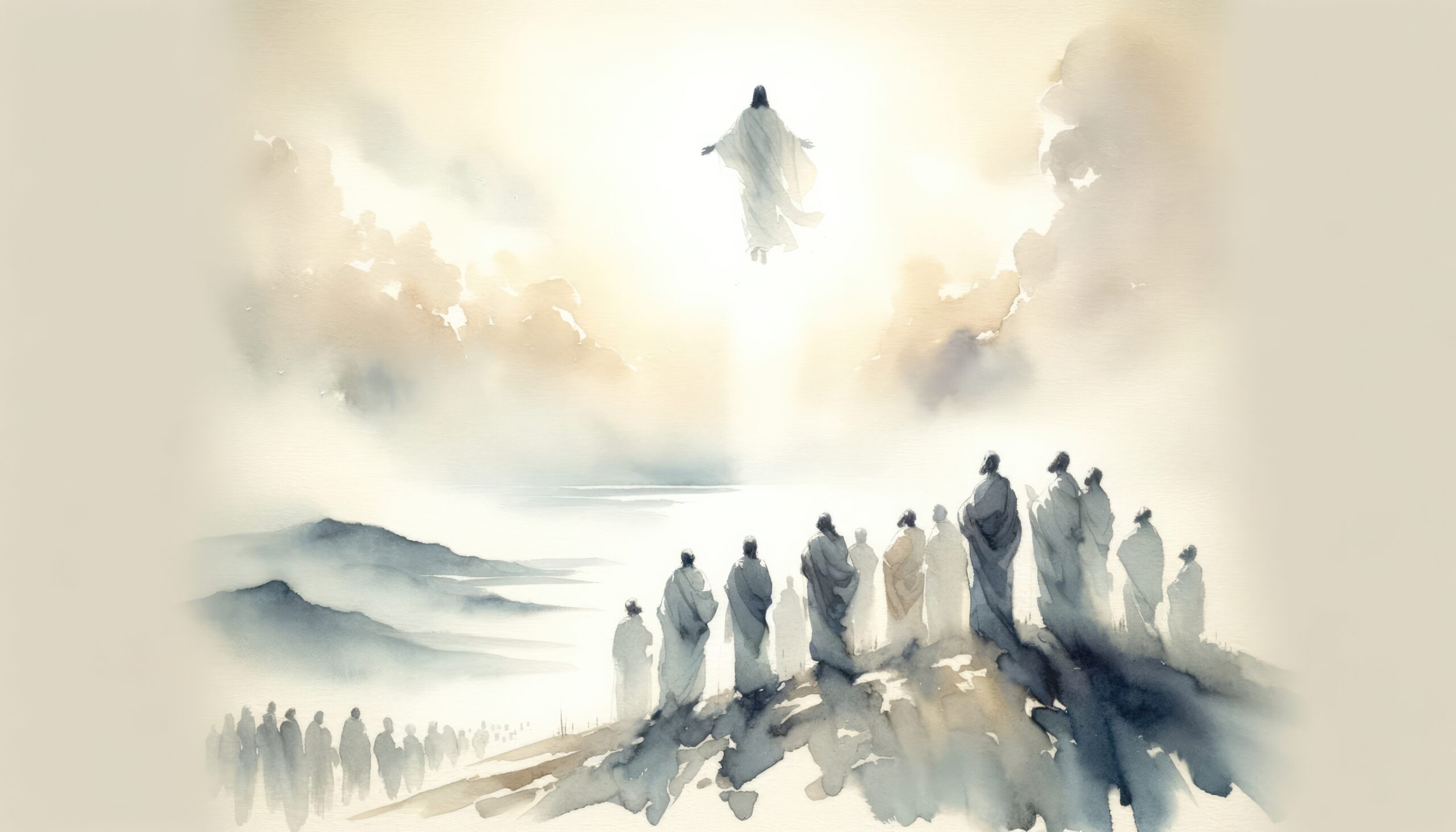
We confess it each and every week. Christ has ascended in both body and soul into heaven. But what exactly does it mean?
It means that Jesus is up there somewhere, and we’re down here, right? Isn’t that what we all think? Actually, that’s not what it means at all! Jesus didn’t leave us when He ascended into heaven. In fact, it’s the exact opposite. Jesus ascended into heaven so that He could be closer to us.
Scriptures teach that when Jesus came to earth and took on human flesh, He laid aside all His power and glory. In his letter to the Philippians, St. Paul says this: “Christ Jesus, who, though he was in the form of God, did not count equality with God a thing to be grasped, but made himself nothing, taking the form of a servant, being born in the likeness of men” (2:6-7). In other words, even though Jesus was always fully God, for a time He chose to not always use His divine powers; He didn’t always look or act like God. In technical terms, we call this the “humiliation of Jesus.”
Practically speaking, it means that the God who created time and space and the laws of nature became subject to His own creation. God—who is omnipotent and omnipresent—limited Himself to be only in one place at a time. He walked from place to place, He ate, He slept, etc. Jesus limited Himself so that He wasn’t with His disciples in Galilee and also with Mary and Martha as their brother Lazarus died in Bethany at the same time. He didn’t feed a crowd of thousands on one side of the Sea of Galilee and at the same time heal a blind man on the other side. And I think it’s safe to assume that had Jesus stayed on earth in the form of a servant, the same would still be true. He couldn’t be with us here tonight and with the Christians on the other side of the world at the same time.
That’s why Christ ascended into heaven, so that, like Paul said, He may be the one who fills all in all. If Christ laid aside His glory and power at His birth, He took it all back at His ascension. Think of the ascension as Christ’s coronation day. That’s why we sing “Crown Him with Many Crowns.”
This is the day God the Father once again places power and authority over all things in the hands of Christ. Paul, in Ephesians 1:20b-22, said that the Father “… seated him at his right hand in the heavenly places, far above all rule and authority and power and dominion, and above every name that is named, not only in this age but also in the one to come. And he put all things under his feet and gave him as head over all things to the church.”
That, by the way, is what we mean when we confess that Jesus is at the right hand of God. The right hand of the Father is not a physical place; it’s a position of honor and power and authority. Think of Joseph being raised to rule over Egypt as Pharaoh’s right-hand man.
And that last phrase from Paul is important! God gave His Son as head to the Church. Christ is a gift to us. This Christ who is seated above all things and who now fills all in all is the Father’s gift to us. This Christ who defeated Satan and who destroyed death and forgives all sins has been given to us. And now He’s not bound by the form of a servant. Now Christ is no longer bound by the laws of nature, which means that Christ can and will be present when and where and how He pleases.
That’s good news for us because Jesus promises to be with us “always, even to the end of the age” (Matthew 28:20). The ascension of Christ means that Jesus really is here in body and soul—His glorified and risen body—speaking to us and preaching to us through His Holy Word. It means that Jesus really is here in this font to make children for God by covering us with His own perfect righteousness. It means that Jesus is truly here with His actual, physical body and blood to feed and nourish us as we walk through the wilderness of this life. When we pray, we can be certain that Christ is with us. When we hear the pastor say that we are forgiven from all of our sins, Christ is there pouring out forgiveness from His pierced hands and side.
Three times during the Divine Service, the pastor turns to the people and says, “The Lord be with you.” Do you ever wonder why? Did you ever think about what’s happening when the pastor says that? Three times: after confession and absolution, after the Scripture readings and sermon, and again after the Lord’s Supper. The pastor doesn’t say that because he’s asking the Lord to be with you. No, he’s telling you, the Lord is with you. Christ is here. He’s the one absolving your sins. He’s the one speaking His Word to you. He’s the one feeding you the Supper. Christ is truly with you. And He’s with all of His children.
On the night before He died, Jesus told His apostles, the same ones who were later caught staring up into heaven, “I will not leave you as orphans; I will come to you. Yet a little while and the world will see me no more, but you will see me” (John 14:18-19). And they would go on to preach and teach that they did see Him—in the same places that we see Him. We see Christ here—at the pulpit, and at the font, and at the altar.
We don’t need to stand around with our mouth open, staring into heaven, waiting to see Jesus. The time will come when Jesus will descend again on the clouds in the same way that He went up, and then we can joyously look to the heavens. But for now, we shouldn’t imagine that we are down here alone, while Christ is up there sitting in the clouds somewhere. No, because of the ascension, He is right here with us.
Praised be the Risen and Ascended Lord.