by Rev. Adam Chandler
People not only consider assisted suicide for themselves but for others. The latter as borderline-homicidal behavior seems to be lost on the decisionmaker due to the distancing from killing, emotionally and possibly physically, assisted suicide creates. Killing, especially actively murdering someone, is a heavy burden for the soul to bear. Typical ways to deal with killing’s guilt is to envision the deceased as less than human or to shield the perpetrator behind a sense of duty. The former is common for pro-abortionists while the latter is more the methodology of assisted suicide, often sloganeered as embodying compassion or healthcare.
Christians recognize there is a call not to kill anyone. (1) “You shall not kill,” calls us to protect life, while we also know sacrificing our lives might be necessary. To be clear: Jesus declares that love is laying down your own life for your friends (John 15:13), not sacrificing your friends’ lives to feelings of pain or despair—whether your feelings or theirs. Suffering in the faith can be considered a virtue in the sense that we endure the evils of the world without ourselves being overcome by evil. Christ, our advocate with the Father, saves us from our sin so that any pain or death we experience in the world will not be the end for us. While in the world, we will have suffering (John 16:30) but the evil of worldly suffering is a price to pay for the preservation of life. This falls under the Law of Double Effect.

Introducing the Trolley
Philippa Foot (1920-2010) was an ethicist who first proposed what would become known as the “Trolley Problem” in 1978. This was in a paper discussing the Law of Double Effect concerning abortion, although I will be discussing assisted suicide here. The Law of Double Effect is recognizing the actions which have both good and evil effects will have a good outcome only at the cost of the evil effect. The evil is not intended nor desired but understood to exist regardless. To explain, let us explore a trolley problem.
You are driving a trolley down some tracks. The breaks give out and you are hurtling forward towards an intersection in the tracks. The path you are on currently will lead to five workers on the track who have no idea you are bearing down on them with certain death. The other track has one daydreamer staring off into the distance unaware of your existence. There will be death but, as the trolley driver, you can choose: keep going on the one track to kill five or switch tracks to kill only one person.
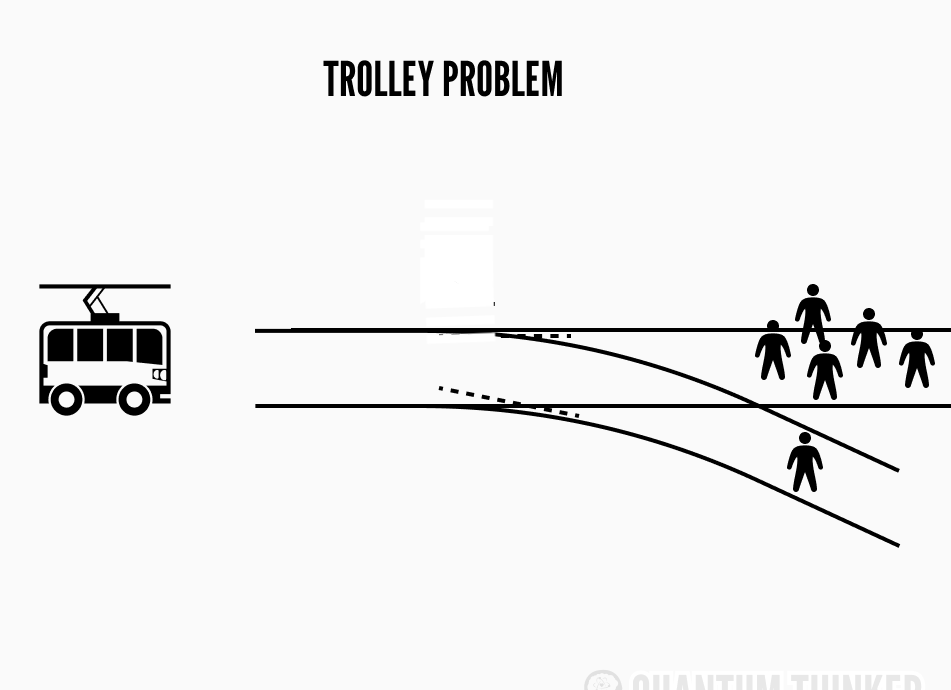
On the one hand, you could say that you had no control over the trolley’s faulty brake system, so you are not completely responsible for any death about to occur. On the other hand, you know that you have the choice to plow over five people or just one, which means you have the agency to chose who lives and dies, thus involving you in the death of whoever is before you. This debate over how involved you are is now the point of the problem. Do you stay on the current track to kill five by doing nothing, or do you make the deliberate decision that the daydreamer dies by switching tracks? The former means you are letting events take their course, although you could have prevented what happened; while the latter would mean you are claiming the life of a person who otherwise would not be affected should you withhold action. Could it be considered murder if a net total of four lives are saved? Or should we even deliberate in terms of a net total since each life is in itself precious to God? Do you have a right to switch or should events merely take their current course?
The majority of people reading about this problem will change the direction of the trolley. You, as the reader, are in a relatively calm environment without real people in front of you who depend on your decision—or lack thereof—to keep them from harm. Rationally, you will come to the conclusion that keeping five people alive at the cost of one life is better than costing five people their lives for the sake of one. (Possibly, you will even reference Star Trek by saying the needs of the many outweigh the needs of the few … or the one.) However, should you find yourself in a real-life version of the Trolley Problem, you might be so emotionally frazzled that you decide it is better to allow five people to die than take on the moral culpability of actively deciding one person die. Why the difference?

Emotions Driving Dilemmas
Moral laws are rational. If they were not, then there would be no point in ever debating morality. We would be simply expressing preferences and emotional intensity. Yet, there has been no moral debate where someone won simply by shouting louder than the other person while weeping or gnashing teeth. People defer to emotional loudmouths all the time but not because they think those overly emotional characters are spouting truth. They are assuaged by sympathy or the desire to avoid negative repercussions from irrational individuals. Moral laws are not won or lost in this, just people’s dignity.
For example, if someone came up to you and said that we need to kill all humans (to protect the environment), then you should rightfully take no confidence in that ethical stance. It is evil on the face of it and not backed with any sort of persuasive data. (2) Ethical problem solving flows from facts and logic. Now, if the person started screaming nonsense at you (still saying humans should die, which you realize might include yourself right here and now if you frustrate this person off even further than they are already), you might agree with this person not due to any correctness in the statement but fear for yourself or nearby bystanders. Placation and self-interest trump moral truth in this turn of events.
In ethical decisions, we should not overlook the influence of emotions. They can cloud our judgment or, if the situation is unclear, possibly streamline our thinking to a correct answer. Moral laws might not be emotional but moral agents are emotional. (3) Heightened emotions, emotional attachments, and feelings of shame can be strong motivators for actions even when a course of action is objectively seen as wrong.
Revisiting the Trolley
Let’s have a variant of the trolley problem. You are no longer the driver of the trolley. You are standing to the side of the tracks next to a switch. The trolley is hurtling down the tracks with no driver! You look down the two sets of tracks to see one set with five workers and the other set with one daydreamer. You can throw the switch and save the five at the cost of the one daydreamer? Think about it for a moment.
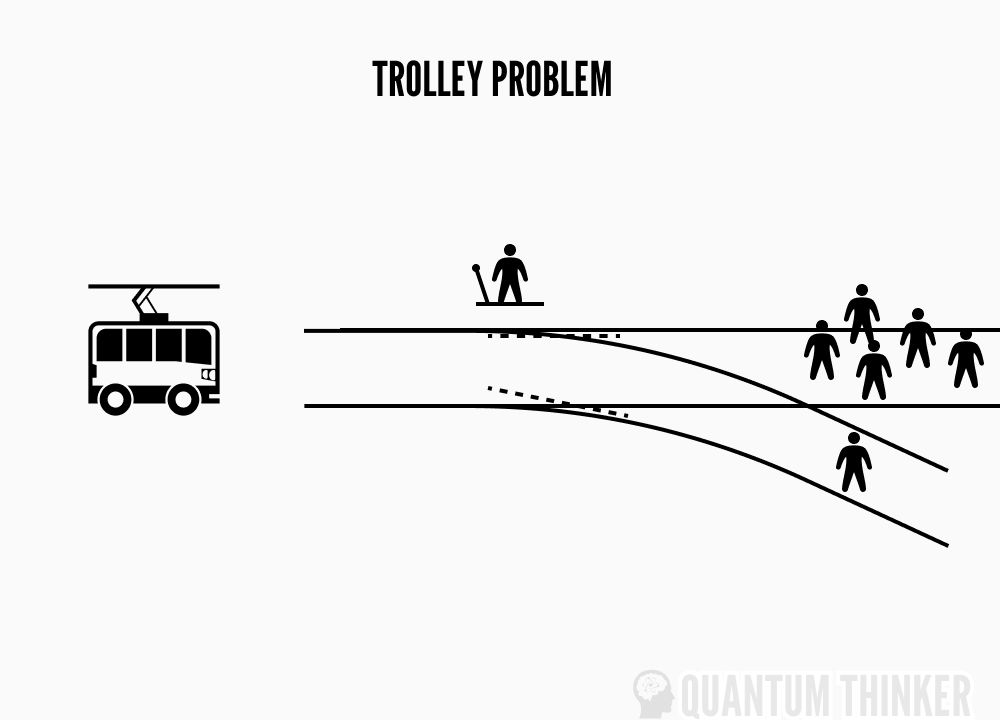
In this new version of the problem, did you feel it was a little easier to make the decision? You might have felt a stronger inclination to throwing the switch and saving the five. Placing you outside the instrument of doom distanced you slightly from the issue at hand. You would no longer be the one suffering the agonizing crunch of bones under the trolley’s wheels. You would be a fair way off. There is less personal involvement and not as strong a sense of shame from being involved in someone’s death.
How about changing the problem again? There is now only one track with five workers and no switch. There is a runaway trolley you are observing from a pedestrian bridge overhead. With you is a man of grandiose size. Perhaps we shall call him Fat Albert? He is bending over the bridge to get a closer look and a slight shove from you could topple him over the side. His proportions are so large that you know this trolley, lacking a cow-catcher, will absolutely be slowed to a halt if he hits the tracks and gets clobbered by the vehicle. You cannot sacrifice yourself because your measly body mass would be cast aside too easily by the trolley and the five workers would be killed anyway. So, would you sacrifice Fat Albert by pushing him to his demise and the workers’ salvation?
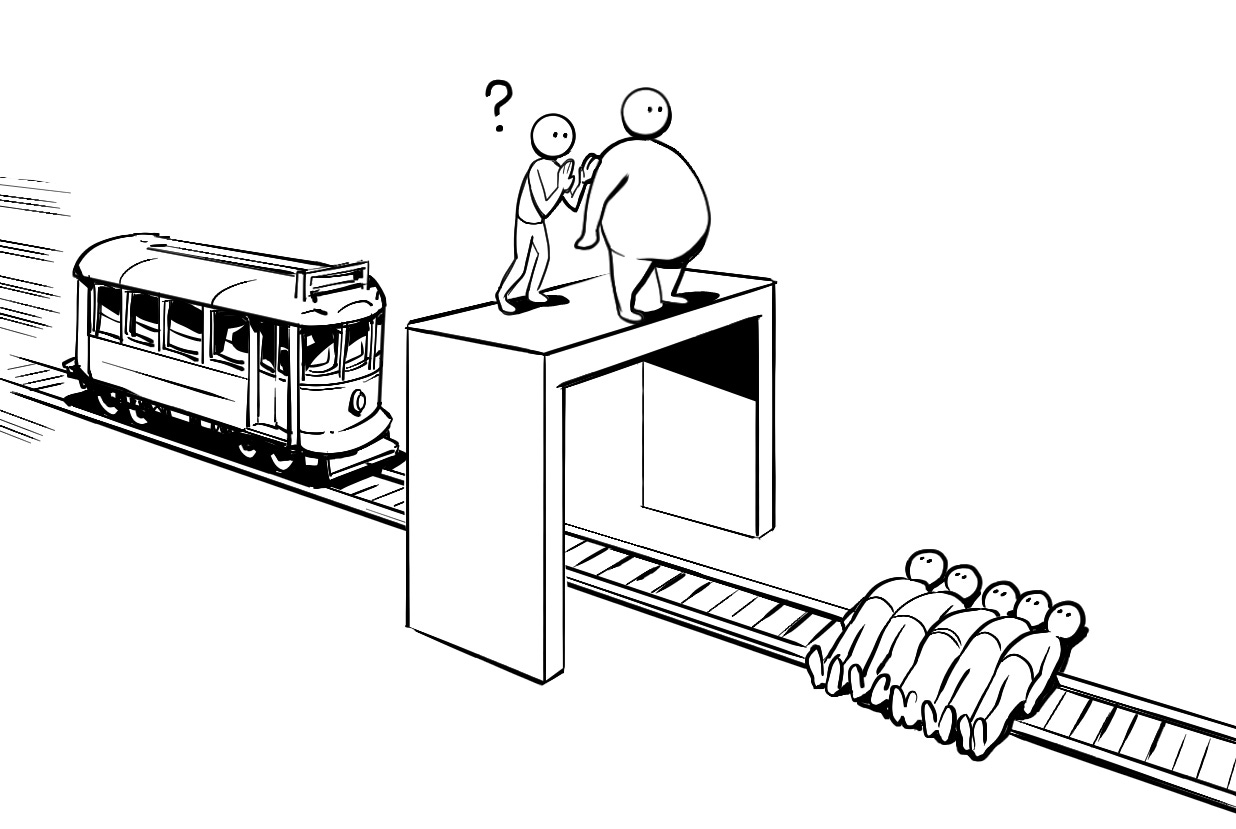
In this version of the problem, you are taking a literal hands-on position. You are not flipping a switch or steering a trolley, you are killing someone in front of you to save five people. Would you do it? Numerically, this problem is the same as the original but it is relationally far different. You can actively kill the gravitationally-challenged gentleman—and you might also possess some complications arising from sympathy for someone sharing a name with a beloved cartoon character.
Lessons from the Trolley
There are many variations of the trolley problem. We can adjust it in many ways, keeping the same numbers of the potential death count while altering how close you are to these individuals physically and personally. How would your decision be affected if the lone daydreamer on the tracks was your mother? How about the daydreamer is a stranger while the five workers on the tracks are the coworkers on your construction crew? You went to go get coffees for everyone only to come back to witness the trolley and the switch right next to you.
The more emotionally and physically invested you are in taking life, the more hesitant you become. So, what bearing does this have on assisted suicide? We can take a look at who is the candidate for suicide. How about yourself? You might feel hesitant if you recognize there are many things to live for. Now, how about your beloved family member as a candidate? You might be capable of killing them if you believe they truly wish to die, but you would likely shy away from delivering the lethal injection yourself. How about another degree of separation where you simply request a medical practitioner to kill your family member for you? You are now an observer. You might have given your consent and followed through with it but now you can simply “let the professional handle it.” Thus, now you have the implied consent of the healthcare profession behind your decision to kill. And what if you were that healthcare professional who has no particular attachment to this person in front of you and the law of the land has given you a medical license to kill that person?

Enter now moral duty. Do we have the responsibility to keep people alive or to kill them? The commandment, “You shall not kill,” would argue that guarding life is our obligation. Yet, people choose assisted suicide for themselves or others affected by their emotional involvement. A person who argues intensely that every person has a right to die might hesitate actively killing his or her mother (and that hesitation would increase if the method of death would be shoving the mother off a bridge to be clobbered by a runaway trolley). An emotional distance can be created by having a doctor kill instead of yourself, or by focusing solely on a feeling of “compassion” instead of a duty to improve your mother’s life.
If you felt your decision to have one person die versus five people die change based on how involved you were in their deaths, then you can see just how much emotion affects you in your decision making. You might realize how much you wish your trepidation over death to be replaced with a feeling of compassion or how welcoming you would be in placing a doctor in between you and a loved one desiring assisted suicide. Still, the moral law we have from God remains, “You shall not kill.”
Life and Death Stories
To honor life is a moral imperative and to take the life of anyone is reprehensible. Yet, when tensions are high and emotions are overflowing, a person might suspend this moral law for themselves or others. Our morals do not derive from emotions but they are influenced by emotions.
I have personally witnessed when a devout Christian questioned whether she should receive medically assisted suicide. This happened right after a medical emergency and she was unsure she was useful anymore in society. A distance was created between how she thought of herself and what she was capable of at that time. Her family recommended MAiD (Medical Assistance in Dying in Canada) and she was thinking about it. After sharing the hope of Christ that the Lord loves her and that, as His servant, I would stick with her through this, she decided against ending her life. It had been a moment of weakness, but the Lord gives us Himself in our weaknesses that we may have His strength (2 Corinthians 12:9-10).
People change their minds. A recent story in Canada finds a woman suffered complications from surgery and declared a wish to die. Her spouse requested MAiD on her behalf and an assessor met with her. In between the time of the initial outcry and this initial assessment, the woman declined to be killed and requested palliative care instead. This was not echoed by her husband who requested a second assessor after a denial of palliative care. This assessor was in favour of MAiD and rushed the claim, refusing the first assessor time to intervene but still managing to find a third assessor fast enough to agree with the new decision. MAiD killed the woman the day of the new assessment. (4) She had changed her mind but other people (implicitly) decided for her that preserving life would not be the compassionate route, against her wishes.
A Slippery Slope for the Trolley
Euthanasia makes it easier and less personal to kill people. Since MAiD has been introduced in Canada, more people have killed themselves each year than the year before. Seeing how “successful” ending people’s lives can be leads to even more legislation to broaden out candidacy for death. Same-day MAiD requests, dying within a matter of hours, make it so the assessors of candidacy have less time to know and understand the candidate for death. This victim also has less time to reflect on the decision, and a shorter timeframe for friends and family to speak against such a course of action.
The satirical cartoon, Futurama, featured devices called “suicide booths” on street corners. They looked and operated like phone booths. Put in a coin, select the mode of death, and then you die in seconds. If MAiD in Canada continues decreasing restrictions, will suicide booths eventually come about in Canada? (5) Hard to say, but the idea of the booth is so impersonal that no one would care if you died there—and that’s the point.

One of the main reasons why people kill themselves is a feeling of estrangement from human contact. And if the process of assisted suicide involves assessors you do not know or family members who think the most compassionate thing is for you to die, then you are lacking strong relationships that would keep you anchored in this world with MAiD.
Dissociation of Personhood
There is a reason why MAiD is used for those whose death is not foreseeable but is instead anchored in deterioration of health—mental or physical. There comes a dissociation from who the suicide victim used to be. He or she was the one who managed the home, earned the household income, and was an active member of the family. When a person cannot define him/herself by their job or by the other ways they contributed, they do not seem to be the same person in a society that is becoming increasingly materialistic. You do not accomplish what you did before, so who are you now?
This dissociation is more evident and far worse with mental health issues where a person cannot recall where they are, what is going on, or who is talking to them. A common saying around dementia patients is that “they aren’t themselves anymore.” If you remember someone as “gramma” but she has no idea who you are and she is having behavioral issues, this person in front of you is suggested to be a complete stranger despite all biological and historical evidence to the contrary. MAiD’s provisions for killing people with mental health issues permits the victim or family to declare where the line is before you cease to recognize them as someone familiar to you or as what is needed to be a person in society.
The issue with all this, of course, is a removal of the perpetrators from the lives of their victims. That wording may sound harsh and that is because I intend it to be. There is no mistaking that assisted suicide remains complicit taking of human life. There is someone who dies in an assisted suicide who would have otherwise lived. That person does not die by his or her own hand, therefore there is someone who instrumentally applies death—someone who kills—and another who is the victim of being killed. Changing the language to neutralize certain emotions is exactly the sort of thing I am challenging in this article. We can quite literally say that the MAiD program in Canada is doctors killing their patients—poisoning them. This is objectively true and should be recognized as such.
Let us address the actual issue: people are arranging the deaths of human beings—patients, husbands, wives, mothers, fathers, brothers, sisters, etc. This is a horrific thing and the horror can be masked over by denying close association with the victim.
God Always Knows You
Human memory can be tricky but the mind of God is something completely different. God is omniscient, which not only means He knows everything right now but that His divine knowledge places you into connection with eternity (cf. Ecclesiastes 3:11). God has always known you, even before you came into existence (Psalm 139:16). You were not an accident. God saw the complete human lineage in His universe and saw you within it. He also knows what will happen when you stand for judgment at His throne in the end. He knows whether you will have Christ and thus be forgiven of all sin, or if you retained your sins and will answer for them without Christ. Those in Christ are written in God’s Book of Life. It is recorded in eternity.
Regardless of what memories you or anyone else has, God knows you and will always know you—even if you seem to have forgotten Him. People who worry about dementia, Alzheimer’s, or other issues related to memory do not have to worry about God. He will continue to remember us should we ever forget our lives. This also means that God is eternally near to you and will not become distant in deciding matters of your life or death. God has prepared Christ’s sacrifice for you that you may be forgiven your sins and enter salvation in the judgment.

God knows that we might dissociate ourselves from others for different reasons which would make killing easier, yet God declares, “You shall not kill.” This universal moral law remains a decree from God Himself. We might think it is more compassionate to kill in certain situations, but God objectively knows and decrees it is not. He maintains there is value in a human life regardless what stage of life it is in.
Therefore, if there is any Double Effect for you, where there is good while there also being evil due to the nature of the world, God will continue to work good for you. We know that for those who love God all things work together for good, for those who are called according to his purpose. (Romans 8:28) When God works all things together for your good, that means all things—even the horrible ones.
Euthanasia and the Law of Double Effect
As described above, the Law of Double Effect recognizes that actions which have both good and bad aspects will result in a bad outcome regardless of if you chose the morally best course of action. In the various cases of the trolley problems, you must choose (or suspend your choosing) of a course of action and a negative outcome will result. If there are two tracks with people who cannot escape on either one, you have to choose which track to go down—and thus which people will die. The morally best course of action would be to minimize badness as much as possible, which would result in as few deaths as possible. Emotions will deviate you from this course of action because they might cause you to freeze, choose people you like (or hate) over others, hesitate in acting if you are too close to taking a life, etc. There might be some rational reasons undergirding these emotional choices (such as realizing that pushing Fat Albert off a bridge to stop a trolley is murder while choosing to switch tracks to kill the daydreamer is closer to manslaughter) but we can make poor choices if we focus on the wrong thing.
Assisted suicide falls under double effect because there is a presumed good to arise from the death of the victim. The most common goods listed are: asserting/protecting personal autonomy, stopping pain, and ending being a burden. These are the presumed goods, but what about the consequent evil from trying to attain these good things? It would be death. Now, if we weigh death against having less personal autonomy, pain, or burdens of various kinds, death obviously outweighs these things. No personal autonomy, pleasure, or benefits exist in death—it is simply death, an end to all that is good.
Since killing is not the best moral choice, especially when God condemns it, what is being weighed in the Law of Double Effect? We are considering choosing life which has the negative outcome of suffering in this world. Suffering is terrible. That is obvious, but we also know that suffering produces character and character looks to hope—a hope beyond the evils of this world, which is exactly what God promises to everyone who hopes in Him (Romans 5:3-5). Suffering also disciplines us as children of God who find new strength from Him to live, and thus makes us more resilient and even sympathetic to others who suffer (cf. Hebrews 12:3-17). The strength of the Lord is what we rely on.
Should we consider our fallible selves, we can probably think of scenarios where we falter to make the best choice, just like we see ourselves quavering in particular trolley problems, such as when our family and friends are involved. We do not want them to die, nor do we want them to suffer. But should we look to what we think is best instead of the moral principles God sets forth and promises to help us through, then we will fail to do what we must at the time. Those who chose euthanasia for their loved ones, enticed because their emotions are jumping back and forth between loving someone to keep them alive and loving them by ending the pain, separating that person from experiencing the emotional weight of taking their loved one’s life (by having a doctor or the government take over) makes choosing death seem like the compassionate option when it isn’t.
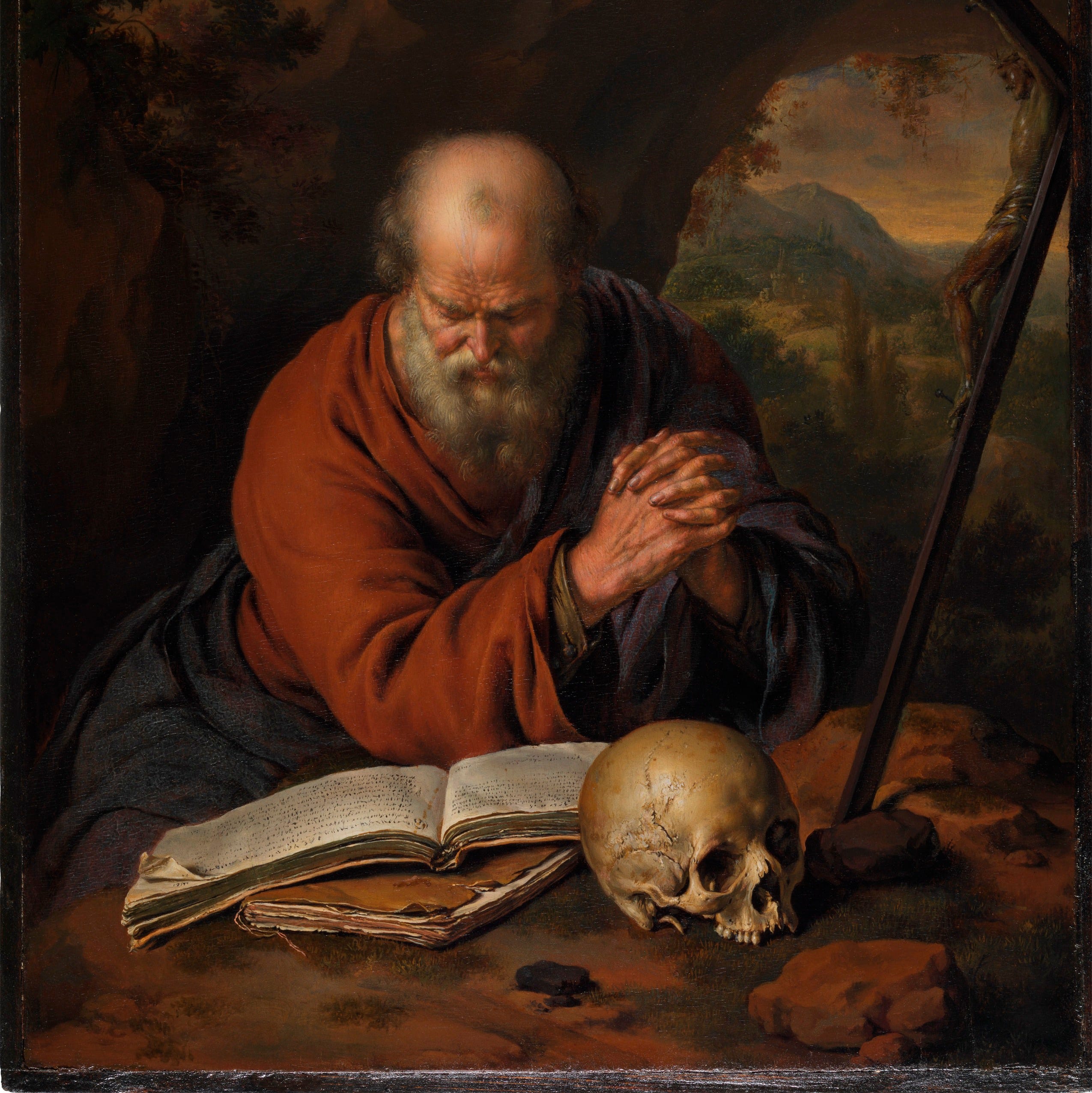
God directs us to choose life, and that means suffering in this world. Suffering will sometimes be greater and sometimes lesser, but there will be suffering. If we are choosing suffering for another person rather than death, we know we are choosing the divine good at the cost of a worldly evil. Therefore, seeing evil either way, we choose the lesser evil and pray to God for strength and any forgiveness we need for not seeing a better option.
In these tough times, for both the people making choices and those who are suffering and considering death, it is best not to rely on our choice alone but God’s direction. We know that we will eventually make a bad call but God is sinless. Therefore, when we are weak, we should rely on His strength, calling upon Him in our time of trouble. And the Lord will be with us in our weaknesses, offering His strength to endure, to pray, and to live because, when we are weak, He is strong (2 Corinthians 12:9-10). Let us take the difficult step in trusting God that He will work all things for our good, even the suffering that does not make sense to us now.
Lord of all life, you created us to live harmoniously with one another in your creation. Help us to love each other as we ought and not distance ourselves from others. When we are faced with hard decisions, do not abandon us but guide us by your scripture and the Holy Spirit that we may do what is best. Forgive us when we fail to live rightly and bring us through the grace of Christ to a blessed end. In Jesus’ name we pray, Amen.
(1) Exceptions would be government-sanctioned execution and the logical extension of this with military defense. I discuss this in the article: https://lflc.substack.com/p/capital-punishment-and-the-christian?r=3ytizy
(2) This is a moral stance that some people have taken. However, they obviously do not agree with it since they are not themselves immediately committing suicide. Therefore, they believe that at least their own lives have moral value, thus denying the claim that it is a moral course of action to kill all humans.
(3) Even in the case of psychopaths who are lacking empathy for the people around them, they still have other emotions. Anger, for instance, can be a major instigator for a psychopath attacking where the judgment is comparing short term satisfaction in hitting a person annoying him against the moral imperative not to cause harm.
(4) Canada: Woman euthanized against her will after requesting palliative care | Euthanasia Prevention Coalition Euthanasia Prevention Coalition: Canadian woman was killed by euthanasia after her spouse requested it for her.
(5) There is already a suicide booth called a Sarco Pod designed to isolate the victim as they breathe lethal gas. Currently, it is illegal for use. Assisted suicide: Sarco capsule deemed incompatible with Swiss law – SWI swissinfo.ch
This article is posted by permission of Lutherans For Life – Canada.