
Download LifeDate Summer 2025 – Every Life Is a Story
by Michelle Bauman, Director of Y4Life
When the time was right, He created you.
I love stories, don’t you? From sweeping sagas of adventure to rags-to-riches tales, I love all of them. And I think I always have. The truth is, I don’t remember a time in my childhood without stories. What I do remember, though, is that it was my mother who engendered in me a love for story first.
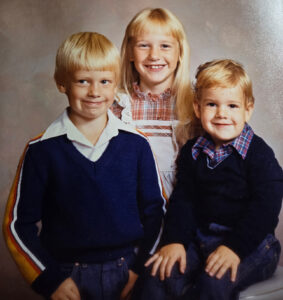 One of my earliest memories is of my mom bravely carting three children under the age of five to the library on a weekly basis. Together, we checked out mountains of books and lugged them home in canvas totes and backpacks, eager to hear the tales they held. Each night after baths were done, we’d snuggle up together on the couch as Mom read to us. Wrapped in warm blankets, hair wet and smelling of Johnson & Johnson baby shampoo, she’d take us on adventures. Together, we’d meet biblical heroes, and unicorns, and baby birds, and talkative tow trucks. Together, we’d gasp in surprise and rejoice in happy endings. Together, we’d make memories.
Dad told stories, too. As we helped him rake leaves or collect marigold seeds for the next season, he filled us with stories of adventure—dirt forts, and playing tricks, and spooky nights in the woods. And when it was naptime, he’d lie on my twin bed, my brother tucked under one arm and me tucked under the other, and he’d read us stories from Sesame Street or Bugs Bunny or Popeye, imitating their voices perfectly.
Yes, almost all of my earliest memories involved stories. And not just from my parents. My grandma told stories of the depression and life on a farm; my grandfather shared stories of time spent in the navy, of deep clear lakes, and of mountain lions. My aunt, a nurse in birthing and delivery, told me stories of mothers and babies.
Stories. They shaped me. They influenced my career choice. And they are still one of my favorite methods for teaching today. Why? Because good, lasting stories ultimately disclose our sinful human condition; they clearly show mankind’s need for a Savior.
Just as powerful, we can relate to stories because, whether we know it or not, we are part of the greatest story ever told. The one that’s still unfolding. The one that will last forever. We’re part of God’s story—the one He’s writing—the story of salvation. And because we’re in God’s story, our story begins even before we were born.
Your story actually began before the creation of the world when God decided He would form you for this time and this place. And because God is good and loving, once He made that decision—to create you as a gift to the world—He began preparing to give you gifts.
He created light and air, water and vegetation. He created land. And all of these gifts were necessary for your life.
But He didn’t stop there. He located the light in sun, moon, and stars so that farmers would one day know when to plant and when to harvest, so that one day you would know when to rest and when to rise. And God continued His preparations by creating birds, fish, and land animals of all kinds—all to uphold human life. All to uphold your life.
It’s at this part of the story, as it is in every good and true story, that we’re introduced to the villain. And this villain, Satan, was devious. Knowing he was no match for God, he attacked the creation God loved most—His son and daughter, both made by hand and both dearly loved.
Wily as he was, Satan convinced God’s beloved they weren’t enough. They could be much more; they could even be gods themselves, knowing good and evil. And because they were convinced they could write their own stories, write a better story than the one God had in store, they changed the trajectory of the plot. They created conflict that could only be resolved by death.
But God did not give up. He kept writing the story of love, the story that would one day include you. He met their sin with His promise: He would send His Son to pay the price. Jesus would come and Jesus would die so that God’s beloved children would live.
And Jesus followed the storyline. He humbled Himself and took on human flesh. He lived a perfect life and died a perfect death to pay for sin. His work righted the story arc; it resolved the conflict and solidified the ending. Jesus rose again, the firstborn of the dead, so that you might live.
But God was not ready to bring you into the story quite yet; He had more gifts to give. He created faithful saints to bear witness to Him, established governments, and made medicines. There were roads to be built and homes with heat and running water to be crafted. He raised up pastors to preach and teachers to teach—more gifts that would be given to you.
And when the time was right, He created you. He gave you a mother and father, siblings and cousins and friends. Even now He provides you a home and shelter, food and clothing, and all that you need in body and soul. All this He does because He loves you.
Your story picks up in this chapter of history. And it is in this chapter that He will work in and through you, just as He did through saints of old, not only to uphold your life but also so that you might uphold the lives of others. Your life is valuable, and your life has purpose. It was not an accident; it was planned from the beginning.
But that doesn’t mean it will be easy. You will experience hardship and suffering. As you age, your body will wear out. Your mind will dull. Your abilities will lessen. And yet, it is in your body with all of its brokenness that the Holy Spirit resides. It is this, your body, that God the Father formed by hand, and it is this, your body, that Jesus, God’s Son, redeemed. And your body, a unique and miraculous gift, will be raised from the dead and made new.
Human lives are short; they fill mere pages in the book of time God is writing. And because of this truth, we may be tempted to think that one life, our life even, is insignificant in the story as a whole. We play small roles, after all; we engage in tiny vocations. Perhaps we’re not needed. Maybe we’re even convinced that our life is, in the grand scheme of things, meaningless. This, too, is a temptation of the wily one. Once again, he is at work to convince us, God’s beloved, that we are not enough.
But the story God’s writing doesn’t lie. We are the reason Christ came. His precious blood proclaims that every human life is inherently valuable. And even if our lives were mere moments, they would still matter because they are miracles, miracles brought about by God Himself.
Miracles happen in moments. Like the moment an egg and sperm are brought together to make a new, unrepeatable and irreplaceable human life.
Like the moment a baby is brought to faith in the waters of Baptism and made an heir of the kingdom of heaven.
Like the moment Jesus feeds us His own body and blood so that we might have both forgiveness and life.
Someday our pages will come to an end even as God’s story arc continues. And just like all of the best and true stories, our story is certain to end well. Yes, there will be loss and sadness for those left behind, those who still have work to do and parts to play, but there will also be joy. There will also be hope. There will also be promise.
The psalmist reminds us of this promise when he proclaims, “I shall not die, but I shall live, and recount the deeds of the Lord” (Psalm 118:17). Indeed, we shall. Whether we live or die, Christians proclaim the goodness of the Lord.
We not only rejoice in the gift of this life, but we also rejoice in the gift of the next because we know how the story ends. Heaven is our home, and Jesus is coming again to take us there. To the world, death looks like an end. But the Christian knows that death is part of the story. It is the last enemy we face; it is the darkest hour before dawn. But because of Christ, dawn will come.
May we, like Job, rejoice in the life, hope, and victory that is ours in God’s eternal story:
“For I know that my Redeemer lives,
and at the last he will stand upon the earth.
And after my skin has been thus destroyed,
yet in my flesh I shall see God,
whom I shall see for myself,
and my eyes shall behold, and not another.”
Job 19:25-27